LECTURE SERIES

Liberation and Civilization: Every Monday

6 lectures to read in sequence.

LECTURE06

2026.07.21

Why do individuals, expert communities, societies, and institutions struggle to revise established beliefs and guidance even when new evidence appears before them?

Liberation and Civilization, Episode 6: Why Is It So Hard to Change Our Minds? — Why Did WHO Take So Long to Recognize Airborne Transmission of COVID-19?

Following the nearly two years it took WHO to state airborne transmission of COVID-19 clearly, this essay examines how the droplet–aerosol dichotomy, disciplinary divides, asymmetrical standards of evidence, and institutional inertia combined with confirmation bias, path dependence, and the Semmelweis reflex. It connects the breaking of personal and institutional worldviews with individual and social liberation.

강의 글 읽기 →

LECTURE05

2026.07.08

If even a Buddha cannot escape the limits of human sensation, memory, and cognition, from what and by what method should liberation repeatedly release us?

Liberation and Civilization 5: The Idol of Tribe and Cognitive Bias

Beginning with dependent arising and conditioned concepts, this essay interprets liberation as continual release from delusion. It connects the human described in the Cave Octad to Bacon’s idol of tribe and the modern Cognitive Bias Codex, examining information overload, insufficient meaning, rapid judgment, reconstructed memory, and confirmation bias.

강의 글 읽기 →
LECTURE04

2026.07.06

If humans cannot become perfect and remain vulnerable to delusion after awakening, what must liberation release us from, why must it continue, and how does personal liberation connect to society?

Liberation and Civilization 4: What Liberation Is and Why It Is Needed

Beginning with Galileo and Kalama skepticism, this essay reads the Snake discourse’s ora-param as worldly and transcendent desire. It interprets the Cave Octad’s binding, covering, hardening, and delusion as the basis of repeated liberation, critiques deification and scriptural authority, and traces private delusion into far-right religion, shamanic politics, martial law, and social power.

강의 글 읽기 →
LECTURE03

2026.06.29

How does testing authority, tradition, logic, and private experience through public observation enable both personal liberation and civilizational progress?

Do Not Believe—Observe: Skepticism from Galileo and Bacon to the Kalama Sutta

A detailed reconstruction of the lecture’s path from Montaigne and Galileo to Bacon and the Kalama Sutta, showing how questions, universal observation, and revision free both individuals and civilization from superstition.

강의 글 읽기 →
LECTURE02

2026.06.19

How can we distinguish fact, ignorance, and inference, and how do metacognition, questioning, observation, and reflection liberate individuals and civilization from delusion and superstition?

What Do I Know? Metacognition and Liberation from AI Hallucination to Socrates and Montaigne

A detailed journey from AI hallucination and human illusion through Buddhist textual criticism, observation of body and mind, Socrates, Montaigne, and skepticism as the foundation of liberation.

강의 글 읽기 →
LECTURE01

2026.06.08

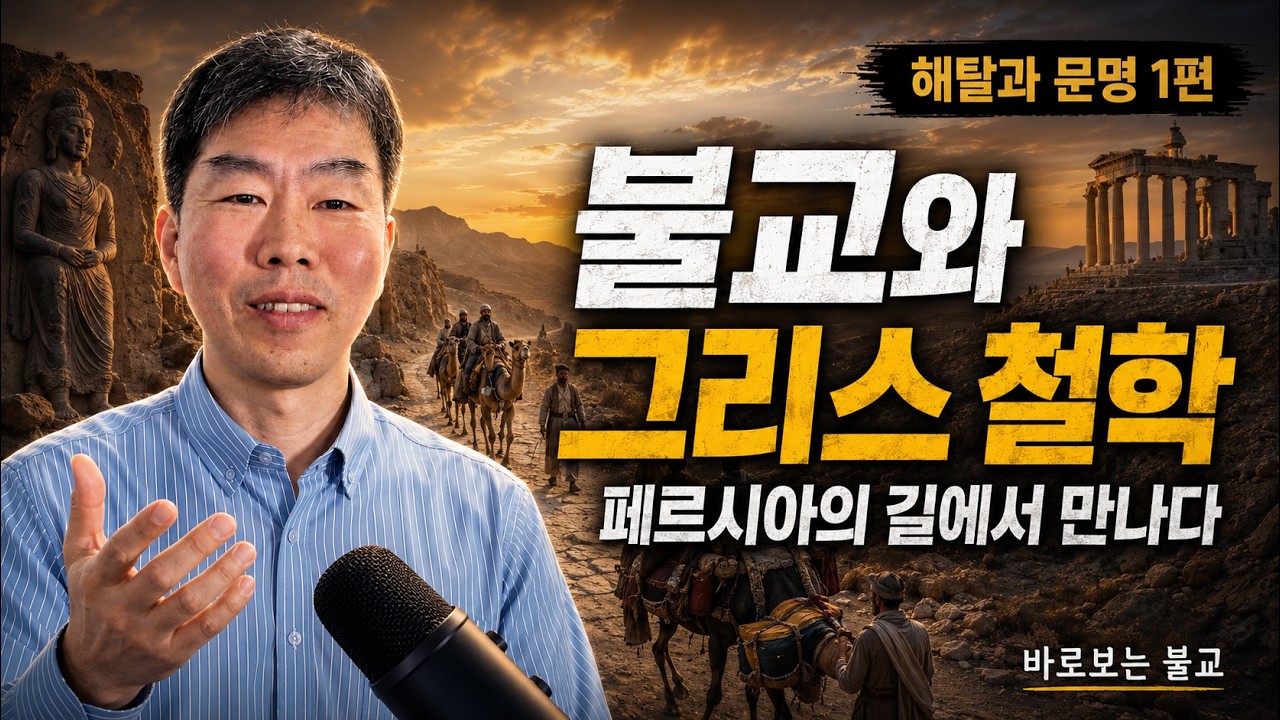
How are personal liberation and civilizational liberation connected, and how did Persian networks and samana philosophy help produce Greek pursuits of tranquility, skepticism, and criticism of power?

Liberation and Civilization 1: Buddhism and Greek Philosophy on the Persian Roads

A detailed reconstruction of the two-hour lecture connecting personal and social liberation with Persian maps and tax roads, Democritus’s travels, Pyrrho in Taxila, Stoicism, Epicureanism, Cynicism, and the wider movement of samana philosophy.

강의 글 읽기 →