THE COMPLETE READING ARCHIVE

Articles written
from the videos.

2026.11.12

Why claim that unobservable, unprovable heavenly realms and hell actually exist, then demand belief in the words of scripture?

A Critique of Monk Ilmuk, Part 2 — The Monk Who Insists That Heavenly Realms and Hell Exist, Without Even Knowing What the Problem Is

I criticize monk Ilmuk’s account that heavenly realms and hell exist and must be believed despite the inability to prove them. Centering on the undeclared and generally accessible observation, I question scriptural authority, supernatural powers, appeals to science, divisions between noble and lowly, and contradictions in selective belief.

Read article →
2026.11.10

Should we accept as fact the claim that a thought immediately before death determines the next life merely because it is written in scripture?

A Critique of Monk Ilmuk, Part 1 — Can a Thought Just Before Death Send You to Hell? On the Superstition Called Early Buddhism

I criticize monk Ilmuk’s account that thoughts and offerings immediately before death can overturn a lifetime of actions and determine the next life. Following the signs of dying and three illustrative cases, I question contradictions in karma and rebirth, scriptural authority, killing and morality, regret and repentance, and the relationship between religion and power.

Read article →
2026.11.06

What should we verify before relying on religious authority and comfort, and how should we judge when love for our family binds our lives?

A Ten-Year-Old Interview with POSTECH Professor Kang Byung-kyun

Watching Kang Byung-kyun’s interview from ten years earlier, I question rebirth, the true self, and divine revelation, distinguishing religious comfort from verification. The criticism leads through the Jogye Order’s social responsibility, family faith, and my father’s alcoholism to the choices we make about our own lives.

Read article →
2026.11.03

Can study that abandons understanding and questions offer wisdom capable of responding to the suffering of actual life?

Critique of the Monk Beopsang, Part 5 — Study Without Understanding Is Useless: Korean Buddhism Ruined by Mindlessness and Anti-Intellectualism

I question Beopsang’s “study that is not understanding” and advice to “live lightly” against the realities of life. I distinguish examining self-created concepts from dismissing real suffering as illusion, and discuss the need for wisdom grounded in dependent arising and ongoing questions that respond to disasters, war, and inequality.

Read article →
2026.11.01

Why is leaving worldly desire to pursue perfection and transcendence another delusion, and how can we question and live within human conditions without becoming attached to either shore, perception, or non-perception?

On This Shore and the Far Shore, Neither Perception Nor Non-Perception, and the Middle Way

I explain leaving both shores as reconsidering worldly desire and the pursuit of transcendent perfection alike. Through the Sutta Nipata and a hypothetical scenario borrowing the Buddha’s biography, I criticize supreme awakening, sameness in waking and sleeping, and complete nondiscrimination, and revisit neither perception nor non-perception and the Middle Way. Viewer questions follow on absorption, non-self, historical sages, and giving.

Read article →
2026.10.29

Why does critically reconsidering mind and concepts turn into erasing the world and death as illusions, and how can we recover wisdom for living within human conditions?

Critiquing the Monk Beopsang, Part 4: The World Is Not an Illusion Made by My Mind—On the Nonsense of “Everything Is Made by Mind”

Watching Beopsang’s lecture, I distinguish seeing the world differently according to mind from claiming that mind creates the world itself. Through brain, body, and mind, non-self and non-arising, and grief at the death of someone close, I criticize explanations that erase reality as illusion. Viewer questions and a preview of the next discussion of the Middle Way follow.

Read article →
2026.10.27

How can we be certain we have confirmed “this very place” if it cannot be explained or compared, and what happens to practical life and wisdom when that certainty stops our questions?

Critiquing the Monk Beopsang, Part 3: When Questions Stop, We Drift Away from Reality—The Effects of the Delusion of “This Very Place”

I examine Beopsang’s Bloodstream Treatise lecture and criticize how an already perfect Way and the confirmation of “this very place” can end inquiry. I explain why language and gestures require distinctions and context, and why doubts after seeing one’s nature should prompt self-observation. I connect neither-one-nor-two and dependent arising with judgments about reality, while also critically reflecting on my own explanation.

Read article →
2026.10.24

Why does the teaching not to be attached to concepts become a demand to eliminate all judgments and emotions, and can pursuing complete nondiscrimination coexist with human empathy and a dependently arisen life?

Critiquing the Monk Beopsang, Part 2: The Delusion of Complete Nondiscrimination

I criticize a cancer-diagnosis story introduced in Beopsang’s Daodejing lecture and ask whether complete nondiscrimination can be the goal of awakening. Through my younger cousin’s death and my own experience of meditative absorption, I explain how feeling emotions and reconsidering attachment can go together. Viewer questions lead to breathing meditation, neither perception nor non-perception, desires and emotions, and the relationship between body and mind.

Read article →
2026.10.22

If we are already awakened, why must we confirm it and listen to teachings, and what attitude and wisdom should awakening reveal in actual life?

Critiquing the Monk Beopsang, Part 1: If We Are Already Awakened, Why Listen to You?

I examine Beopsang’s explanations of original Buddhahood and no attainment, asking why confirmation and teaching are necessary if we are already awakened. Distinguishing meditative comfort from wisdom, I explain liberation and Buddhahood as an ongoing attitude of observing dependent arising and reflecting on oneself. Viewer questions extend the discussion to superstition in scripture, temple authority, and money.

Read article →
2026.10.20

As AI transforms scientific research and jobs, will we keep treating it as someone else’s problem until it happens to us?

AI Solves 98% of Unpublished Physics Problems: A Shocked Physicist’s Sleepless Nights

AI solved 49 of 50 unpublished physics problems and even uncovered errors in experts' calculations. I ask why we feel the shock only when it becomes our own problem. Through young people's job losses, politicians' responsibility to respond, and four AI agents cooperating in Minecraft, I discuss changes that society must prepare for together.

Read article →
2026.10.17

Can we become wiser without questioning our own thoughts and emotions, and the words of authority figures?

What If Humans Cannot Understand AI’s Judgment? Questioning and Reconsideration as Buddhist Practice

If a doctor cannot understand what AI has detected, must the final judgment always belong to a human? Beginning with a conversation among friends, I critically examine Cheonghwa's statements and explain why practicing reflection on fast-moving thoughts and emotions is Buddhist practice.

Read article →
2026.10.15

Can we speak of restoring honor and practicing Buddhism without apologizing and repenting for wrongdoing?

Asking Questions or Having a Conversation

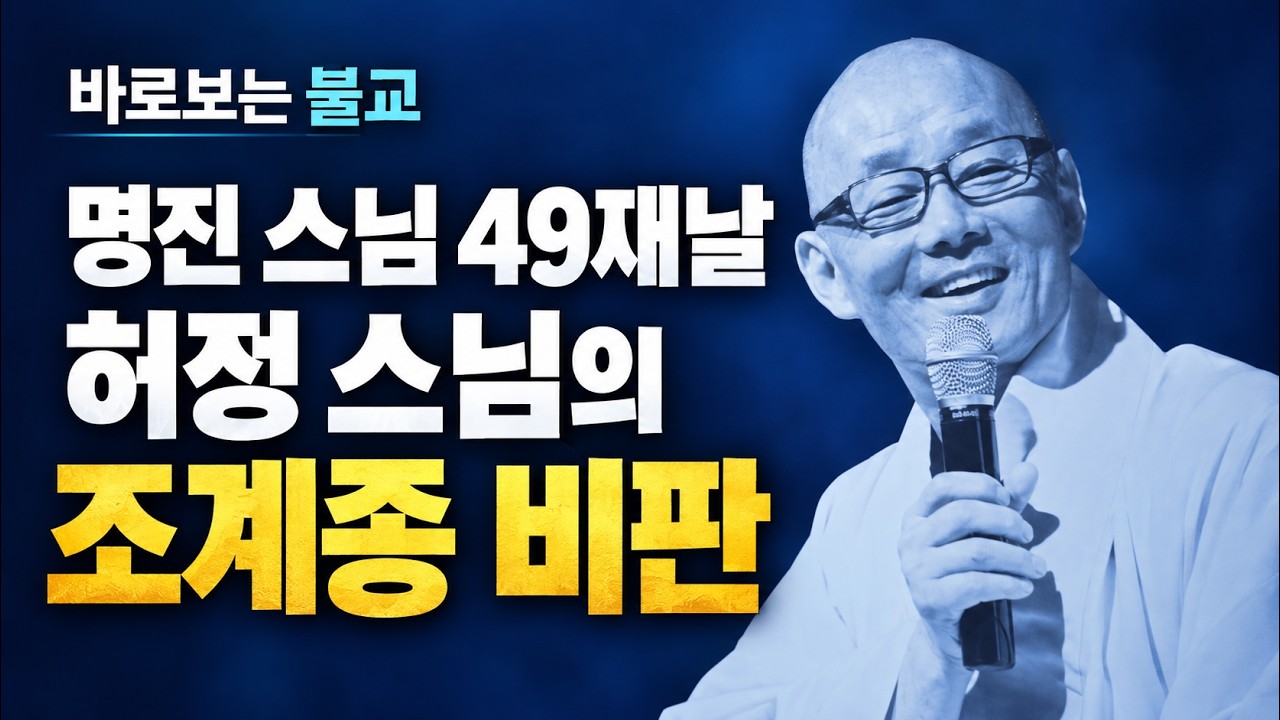
Prompted by Myeongjin's forty-nine-day memorial and posthumous Great Master title, I read Heojeong's criticism of restoring honor without an apology. I examine religious people's social responsibilities and the Jogye Order's problems, and discuss why acknowledging past wrongs is also essential to individual Buddhist practice.

Read article →